How to Arrange a Side-by-Side Tasting
A side-by-side tasting is a board built to answer a question. Does rye or oat suit this cheddar better? What does fennel do to a sheep's cheese? The layout, the order and the timing decide whether guests can actually taste the answer.
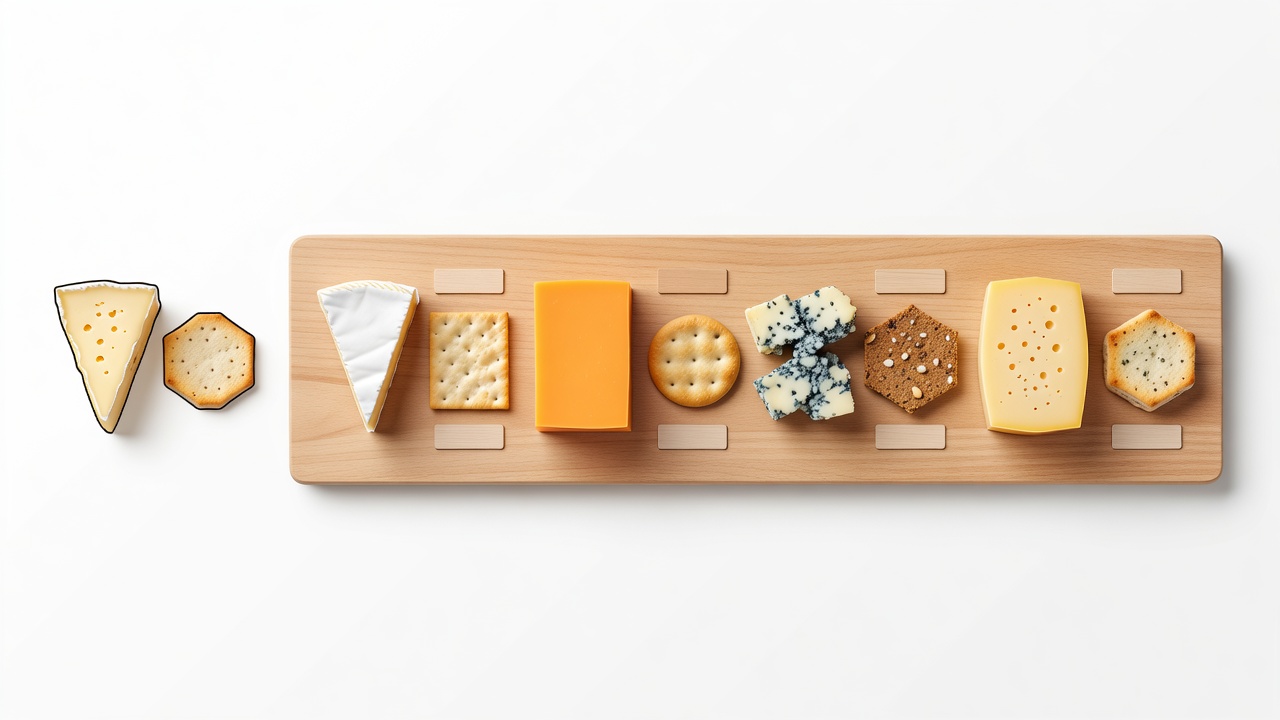
Decide what the tasting is asking
Start with one question. "Which biscuit suits which cheese" is too broad for a single board. Narrower questions produce clearer tastings: one cheese against four biscuits; four cheeses against one biscuit; or a regional pairing, such as Scottish cheeses with oatcakes, set beside a different tradition's cheeses with their own biscuits. Holding one element steady lets the other one speak. If you change both cheese and biscuit at every step, guests will remember what they liked but not why. Write the question down, even just for yourself. It helps when you are tempted to add a fifth cheese at the last minute.
Keep the variables few
Three to five cheeses is a workable range for most home tastings; beyond that, palates tire and the differences blur. Two or three biscuits per cheese is plenty. If one biscuit is flavoured, keep the others plain so the flavour has something to be compared against. Drinks add another variable. Water is the neutral choice for a first tasting. Wine, cider, beer or tea can follow once the pairings themselves are understood, and each will shift the salt and fat balance in its own direction.
Order from mild to strong
The usual sequence runs from fresh and mild to strong and pungent: fresh cheeses, then soft bloomy rinds, then firm and hard cheeses, then washed rinds and blues. The logic is practical. A strong cheese leaves aroma and fat behind, and a delicate cheese tasted afterwards seems flat. Within a group, go from younger to older. Lay the board out in the same order the cheeses should be eaten, left to right or clockwise, so guests follow it without instruction. If a flavoured biscuit is involved, place it later in the sequence rather than at the start, for the same reason.
Temperature and timing
Cold mutes flavour and stiffens texture. Most cheeses taste fuller after resting out of the refrigerator, often for around an hour, though a warm kitchen shortens that and a cold room lengthens it. Soft cheeses can turn runny if left too long. Biscuits run on the opposite clock: they start crisp and soften as they take up moisture from the air and from the cheese. Keep them in their packet or tin until shortly before guests sit down, and do not pre-spread cheese on crackers unless they will be eaten within minutes.
Cutting and portions
Cut each cheese so every piece includes a fair share of the paste from centre to rind, since flavour changes across that span. Wedges are cut as thin slices from the point outward; round soft cheeses into narrow segments; blues so each piece has some of the veined centre. For a tasting, small is better: a piece that fits a biscuit in one bite lets guests repeat the comparison. Quantity depends on whether the board is a snack, a course or the whole meal, so judge by the occasion rather than a fixed weight.
Placing biscuits so pairs read clearly
Set each biscuit directly beside its intended cheese, not in a shared pile at the edge of the board. Leave a visible gap between pairs. Give each cheese its own knife where possible, so a blue does not travel into the goat's cheese. A small card naming the pair, for example "Lanark Blue, oatcake", does a lot of quiet work. If you want guests to compare two biscuits with one cheese, place the cheese in the middle and a biscuit on either side, so the comparison is built into the layout.
Resetting between pairs
Water does most of the work. A plain, unsalted or lightly salted cracker set apart from the pairs gives a dry, starchy reset. Slices of tart apple are used in many households for the same purpose; their acidity cuts fat. Avoid using strongly flavoured nibbles such as olives or pickles as resets during a tasting, since they leave their own salt and acid behind. They belong on a board that is meant for grazing rather than comparing.
Keeping crackers crisp
Crackers soften because they absorb moisture. Store them airtight, away from the cheese and from steamy kitchens. If they have gone limp, a few minutes in a low oven followed by cooling on a rack usually restores the snap; they crisp as they cool, not in the oven. Do not refresh crackers sitting next to cheese on the board. Put out a smaller quantity and top up during the evening instead, which keeps each new handful at its best.
Tables that serve cheese differently
A side-by-side board is one custom among many. These habits show other reasonable ways to bring cheese and biscuit, or bread, together.
In many French homes cheese is a course of its own, served after the main dish and before dessert, and eaten with bread rather than crackers. A baguette's crust supplies the crunch, its crumb a soft neutral base. The custom shows how much a carrier's plainness can matter.
At bars across Spain, wedges of Manchego often arrive with picos, small crunchy breadsticks, and sometimes with membrillo, a firm quince paste. The quince adds the sweetness; the picos simply carry. Cheese here is part of a shared spread rather than a separate course.
The British cheese board tends to come at the end of a meal, with water biscuits, oatcakes or digestives, often chutney and celery, and at Christmas a Stilton with port. In Yorkshire, Wensleydale is traditionally eaten with fruit cake, a pairing that puts sweetness in the starch itself.
In Sweden and Norway, crispbread with butter and thin slices of hard cheese is ordinary breakfast fare. The thin slices come from the cheese slicer patented by Thor Bjørklund in Norway in 1925, a tool that changes the ratio of cheese to biscuit completely.
In Puglia, taralli appear with a glass of wine before dinner, often beside olives and a young cheese. In Emilia-Romagna, Parmigiano Reggiano is commonly broken into rough chunks and eaten on its own, sometimes with a drop of aged balsamic vinegar.
For the biscuits themselves, see oatcakes, taralli and other table biscuits.