Oatcakes, Taralli and Other Table Biscuits
Savoury biscuits grew out of local grain, local fat and the need to keep bread-like food for longer. The results differ in snap, salt and smell, and each was shaped by what it was eaten with. Some were made for cheese; some never met it. All of them explain something about pairing.
Scottish oatcakes
Oatcakes are made from oatmeal, a little fat, salt and hot water, rolled thin and baked. Traditionally they were cooked on a girdle, the Scottish griddle, as a round that was cut into four quarters called farls. The grind of the oatmeal sets the texture: coarse oatmeal gives a rough, nubbly biscuit with an open crumb, fine oatmeal a smoother one that snaps more cleanly.
Beside cheese, oatcakes are partners. Their toasted, slightly sweet grain softens salt and sharpness, which is why they sit so naturally with a mature Scottish cheddar such as Isle of Mull, with the blue Lanark from South Lanarkshire, or with crowdie, the soft fresh cheese of the Highlands. One naming caution: a Staffordshire oatcake, from the English Midlands, is a soft, floppy pancake, eaten hot with fillings. Same word, different food.
Taralli
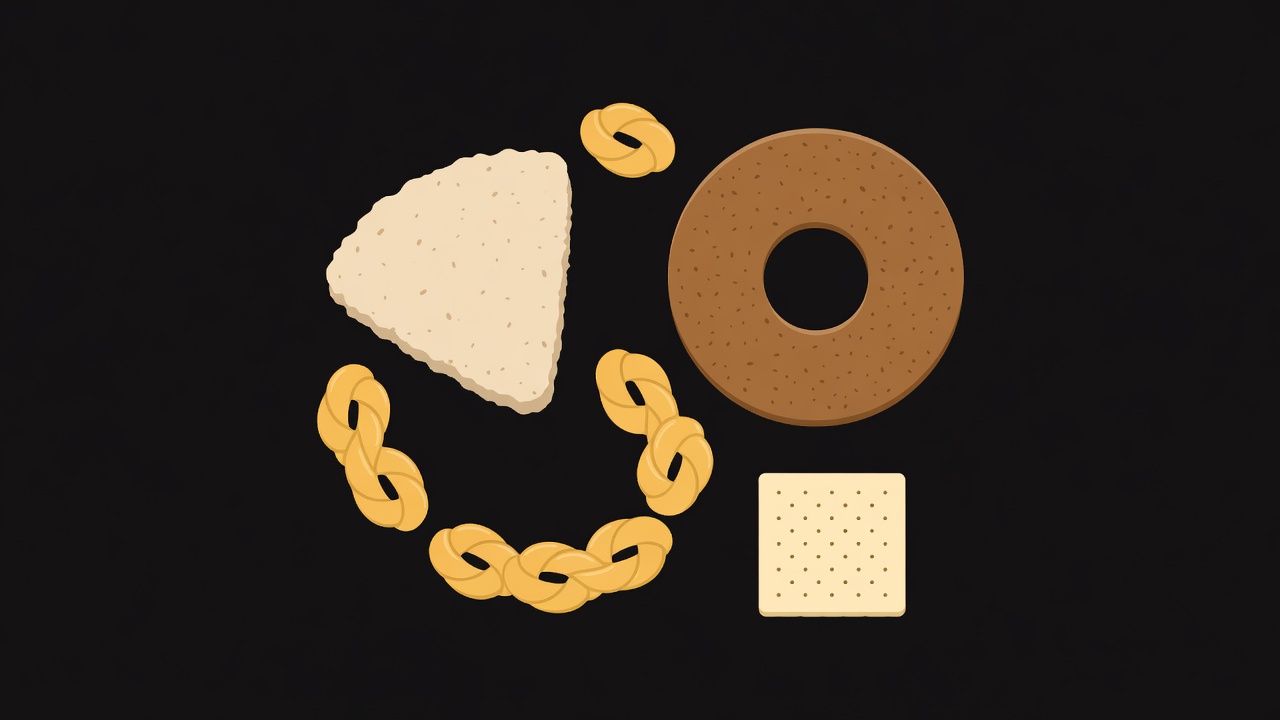
Small rings of wheat flour, olive oil, dry white wine and salt from the heel of Italy. Many are briefly boiled before baking, which sets a smooth, glossy skin and a dense crunch. Fennel seed is the classic flavouring, with black pepper and chilli common too. Taralli usually lead a pairing rather than carry it, so they suit mild, salty cheeses such as a young pecorino or ricotta salata, and a glass of wine.
Neapolitan taralli
Naples makes a larger, richer cousin: taralli with lard, coarse black pepper and whole almonds, sometimes called taralli sugna e pepe. The lard gives a short, crumbly texture very unlike the hard Apulian ring. On a board, their own fat and pepper are already a full flavour, so a plain cheese and a cold drink are enough company.
Grissini
Thin, dry breadsticks associated with Turin, where tradition places their origin in the late 1600s. Hand-rolled grissini are knobbly and irregular; machine-made ones are uniform and very brittle. They carry rather than lead, and in Piedmont are as likely to be wrapped in a slice of cured ham as eaten with cheese.
Regañás and picos
Regañás are thin, blistered, crisp flatbreads from the Seville area, often scattered with sesame. Picos are small crunchy breadstick pieces sold by the bagful. Both turn up at bars beside cheese, cured ham and olives. Their dry wheat flavour is a plain carrier for Manchego and other firm sheep's cheeses.
Knäckebröd
Rye crispbread, historically baked as large rounds with a hole in the centre so they could be threaded onto a pole and stored dry near the ceiling through winter. The rye gives a sour, earthy depth, and the texture is a hard, clean snap. Eaten with butter and sliced hard cheese, such as the strong, granular Västerbottensost from northern Sweden.
Cream crackers
Developed in Dublin in the 1880s, cream crackers are made from a laminated dough that bakes into thin, flaky, blistered layers. Despite the name, they are not especially rich. The layers flake rather than snap and hold soft cheese well. Split one across its thickness and you can see the strata clearly.
Water biscuits and digestives
The water biscuit is flour, water, a little fat and salt, rolled very thin and docked with small holes so it bakes flat. It is the archetypal neutral carrier. The digestive, a sweet-meal biscuit with wholemeal flour, is technically a sweet biscuit, yet many British families eat it with cheddar, because its sweetness works against salt.
Khakhra
Thin wheat flatbreads roasted slowly on a griddle and pressed until brittle, often flavoured with fenugreek leaves, cumin or chilli. Eaten at breakfast or with tea, frequently with pickle or chutney rather than cheese. Their toasted wheat and herb notes show how far a cracker can go as a dish in itself.
Mathri
Flaky, fried savoury crackers made with flour, fat and often ajwain, the carom seed with a thyme-like sharpness. Mathri belong with masala chai and mango pickle, and are made in quantity for festivals. Their fat and spice make them a complete snack; a cheese board is simply not their setting.
Senbei
Rice crackers, grilled or baked, many brushed with soy sauce and some wrapped in nori. The town of Sōka in Saitama is especially known for them. Senbei are eaten with green tea. Their savoury soy glaze works on its own terms, a reminder that not every crisp savoury biscuit is looking for cheese.
Lavash
A thin flatbread baked against the wall of a tonir oven. Dried lavash keeps for months and is softened with a sprinkle of water before eating. Its preparation and cultural meaning in Armenia were inscribed on UNESCO's intangible heritage list in 2014. Wrapped around white cheese and fresh herbs, it shows a pairing built on softness rather than snap.
Reading a biscuit by its role
Across these traditions three roles keep appearing. Carriers, such as water biscuits, grissini and picos, have little flavour and a clean texture; they let the cheese speak. Partners, such as oatcakes, rye crispbread and digestives, bring grain sweetness or sourness that changes how salt and fat read. Leads, such as fennel taralli, peppery Neapolitan taralli, khakhra and mathri, carry so much flavour that the cheese, if any, plays the supporting part.
None of these roles is better than the others. A Scottish host offering oatcakes with cheddar and a Pugliese host offering taralli with wine are each serving a balanced pairing; they have simply put the flavour in different places. For how herbs and seeds create those leading flavours, read when rosemary outlasts the cheese.